. . . because much of the content relates both to Washington, D.C., and "outside the beltway" -- the heartland, specifically Iowa -- and because after going from Iowa to Washington via Texas and California I subsequently returned, From DC 2 Iowa.
[See below, at bottom of this blog entry, for comment exchange.]
Should Sports Allow Drugs that Enhance Performance?
Nicholas Johnson
The Gazette, August 17, 2016, p. 5A
I'm not proud to say it.
It was the 1960s. Illegal drugs were everywhere. I was a young lawyer, living as a hippie-public official. That’s what kept me from drugs – not health concerns, personal discipline, or common sense. Illegal drugs simply couldn’t be part of my life.
That doesn't mean I'm a fan of our "War on Drugs."
Illegalization has promoted more crime, not less, probably contributing even more deaths from the use of guns than from drugs. Because there's no quality control of illegal drugs they’re even more deadly. It's occasionally involved our government in the cocaine trade.
Not only has it cost taxpayers billions of dollars, it has simultaneously kept the government from collecting taxes on sales (as it does with alcohol and tobacco).
When it rarely produces a dip in supply, that simply drives up street prices and profits for dealers. It’s made us the number one nation for percentage of incarcerated citizens -- including more blacks working as prison laborers today than once worked as slaves.
So what’s the alternative?
In 2001, Portugal repealed criminal penalties for possession of marijuana, cocaine, and heroin. Fears of increased costs and consumption proved unwarranted. Health services for addicts were cheaper than incarceration. Teens' drug use and HIV from dirty needles declined. Addicts seeking treatment more than doubled.
The elephant in the Rio Olympics’ venues – performance enhancing drugs (PED) – brought Portugal’s experience to mind.
Athletes’ PED use began with the first Olympics 2000 years ago, 776-393 BC. Today it’s present in most sports, and from high school, to college, to the Olympics, to professional athletes. Efforts to stop it have proven as futile as our 1920s prohibition of alcohol, and more recent War on Drugs.
If only ineffective it would just be a waste of money. As it is, it also infuses otherwise honorable, sportsmanlike contests with subterfuge, lying, and deceit – to the harm of sports’ fans, athletes, and our children. It risks athletes' health from the lack of physician monitoring and the use of unsafe, untested substances and dosages. It encourages a contest of escalating sophistication in the design and detection of ever more difficult-to-detect substances.
Need athletes be protected from themselves? Injuries and death occur in many sports; athletes "assume the risk," legally and morally – think brain injuries from football. Shouldn't adults be as free to do their own benefit-cost risk assessments of doping as of any athletic or other risk?
Want a level playing field? It doesn’t exist.
Many things can enhance performance. Athletic parents who start training their three-year-olds. Poor students who run five or ten miles each way to school. Wealthy parents who provide private coaching and clubs, and free their college athletes from the need to work. Coaches with the equipment and knowledge of sports science (including diets) to maximize training efficiency. Working out at higher altitudes to gain an oxygen boost upon return.
Doping also can and does affect performance. But because it is also illegal, surreptitious, and widespread, it creates a terrible conflict for coaches and athletes – dope and risk getting caught, or comply with the rules and risk adding the hundredths of a second that can separate winners from losers.
Perhaps organized athletics, including the Olympics, should consider abandoning their ineffective anti-doping efforts. Perhaps they should consider the sports equivalent of the Portugal approach. Let doping join the long list of other things by which athletes and coaches can enhance performance – with approved drugs, dosages, and supervision by medical doctors and pharmacists.
A perfect solution? Of course not. But with a 2000-year history of failed bans, it may be a least-worst option worth trying.
Given today’s widespread doping in all sports, the competitive results would be little different. But it would be safer, less deceitful, and create a more honorable and level playing field for athletes, coaches, and fans alike.
_______________
Nicholas Johnson, a former sports law professor, lives in Iowa City. Contact: mailbox@nicholasjohnson.org.
Comments
Gary Ellis provided the following response by email to this column:
Saw your piece in the Gazette. Got to ask, aren't you just saying that if it feels good do it? Is there any morality of what is right and wrong?
Perhaps we should just stop spending any public money on sports and let it survive on its own? Maybe we should do away with some of the celebrity status of activities like sports. Society would be better off if we focused on science and economics where our goals would be to improve the human existence.
To which I replied by email:
I can see how what you say in your first sentence could be a reader's take-away from the column.
There's law, morality, and there're also public health issues. But there's always that balance between personal freedom and self-imposed harms of such severity as to warrant what the opponents of regulation call "the nanny state."
For example, tobacco use is the single greatest cause of Americans' deaths. Alcohol is the nation's number one hard drug by every conceivable measure. We have anti-tobacco and alcohol encouragement, education, treatment centers and so forth -- but we do not ban the sale of either. That also could be said to be a form of "if it feels good do it."
Your second sentence is something I've advocated over the years (splitting the money collegiate sports off from universities) and that has some support from at least some athletes and agents.
Update, August 6, 2016: I have a confession. Some of the blog posts at FromDC2Iowa are triggered by a news item, some follow a considerable amount of research, others are simply the sharing of an idea floating through my brain -- the motivation for this one on July 23. To the best of my memory I had never before read of a proposal to deal with athletes' doping by simply eliminating the prohibition. It was just a brief idea that I thought worth sharing.
This morning [August 6], while making coffee, I caught a bit of the discussion on Bill Littlefield's "Only a Game," on NPR. A guest was expressing some of the same ideas regarding doping that I'd written about here a couple weeks ago. With a little research I tracked down an article that guest had written. I'm always pleased, rather than disappointed, to find that an "original" idea of mine has occurred to professionals who really know what they're talking about.
Here are some excerpts from Patrick Hruby's article:
Doug Logan had seen enough. For years, he had served on the front line of the sports war on performance-enhancing drugs, first as the commissioner of Major League Soccer, and later as the chief executive officer of USA Track and Field. For years, he believed in the fight. . . .
This was a war, Logan began to realize, with few victories. . . . In an online [2013] column titled "May the Best Meds Win," he called the sports war on drugs hypocritical and unwinnable. A quagmire. . . . If athletes break criminal laws, then let them face the consequences; otherwise, let them decide what's best for their bodies.
For decades, the sports world's response to PED use has been . . . : zero tolerance. Police and punish. No retreat, and certainly no surrender. . . .
However, a small group [has] started to challenge that view. The war on doping, they contend, has done far more harm than good: wasting money, retarding medicine, fostering corruption, and trampling on athletes' rights and dignity while failing to protect their health. The ongoing Russian scandal . . . resulting in at least 111 Russian athletes being banned from Rio -- is not, to them, a meaningful victory. Rather, it's a sign of ongoing defeat. Sports keep fighting. Drugs keep winning. Wouldn't it be safer, rational, and arguably more honest to end PED prohibition? To permit, study, and regulate the drug use that already happens regardless of the rules?
I'm not proud to say it. It wasn't a matter of health concerns or rigid discipline. As a licensed lawyer and public official at the time there was no alternative -- even while living as a hippie-public official. Illegal drugs could not be a part of my life. And so it has been to the present day.
That doesn't mean I'm a fan of our "War on Drugs." It seems to me that it has just promoted more crime, not less. It has, thereby, probably contributed to more deaths from the use of guns than from the use of drugs. Moreover, because there's no quality control of illegal drugs they cause even more deaths. It's occasionally involved our government in the cocaine trade. Not only has it cost taxpayers billions of dollars, it has kept the government from collecting taxes on drug sales, like it does with alcohol and tobacco. On occasions when it produced a dip in supply, it's simply driven up street prices and financial reward for drug traffickers. It has made America number one among nations in percentage of incarcerated citizens -- including more blacks working as prison laborers today than once worked as slaves.
In 2001, Portugal repealed all criminal penalties for possession of marijuana, cocaine, heroin and methamphetamine. Fears of increased consumption proved unwarranted. Health services for addicts were cheaper than incarceration. There was a drop in teens' drug use, and HIV infections from dirty needles. The number of addicts seeking treatment more than doubled. See, e.g., Maia Szalavitz, "Drugs in Portugal: Did Decriminalization Work?"TIME, April 26, 2009.
This all came back to mind while reading the latest episode in sports' longest-running drama: the unsuccessful efforts to prevent athletes doping to improve performance. This time the accusation is that Russia has a state-supported doping operation that threatens to ban all of its athletes from performing in the forthcoming Olympic games. There has been so much written about what The Guardian calls "The Russian Doping Scandal" that it has devoted an entire section of its Web site to links to the stories.
Doping has been going on for at least 2000 years. ("The use of drugs to enhance performance in sports has certainly occurred since the time of the original Olympic Games [from 776 to 393 BC]. . . . [A] viscous opium juice [was] the drug of choice of the ancient Greeks." Larry D. Bowers, PhD, "Athletic Drug Testing,"Clinics in Sports Medicine, April 1, 1998.) No wonder stopping it has proven to be an unwinnable challenge in virtually all sports, and from high school, to college, to the Olympics, to professional athletes.
As for the Olympics, The New York Times reports, "Results from the second wave of retesting [brought] the total number of implicated athletes to 98. The new results affected 30 athletes from eight countries who competed in four sports in Beijing, and 15 athletes from nine countries who competed in two sports in London, according to the I.O.C. . . . Revelations of a government-run doping program in Russia have called into question global sports’ antidoping system, as well as sports officials’ willingness to expose drug offenses. . . . [I]n a cat-and-mouse dynamic, both testing methods and doping methods have gotten more sophisticated, with those seeking to beat the system devising new ways to skirt detection." Rebecca R. Ruiz, "Russia’s Paralympic Team Is Facing a Ban of Its Own,"The New York Times (online), July 23, 2016, p. A1.
The UCLA Bruins Coach Red Sanders' saying (often erroneously attributed to Vince Lombardi), "Winning isn’t everything; it’s the only thing," describes the attitude of many coaches, athletes, fans, and sports reporters. That being the case, why should anyone care about doping? Equipment changes enhance performance -- from pole vaulting poles, to baseball bats, golf clubs, and their balls. These and other techniques are not deemed unsportsmanlike, even though they make it difficult to compare yesteryear's record books with today's.
Doping is different. Since it is banned, those who do it anyway are considered to have cheated their way to an unfair advantage. In contests where hundredths of a second can make the difference between a medal winner and an also ran, it's the individualistic equivalent of an entire team conspiring to throw a game. But many things are done to enhance performance -- training in the scientifically most efficient way, training at a higher altitude (gaining an oxygen boost upon return), or controlling diet. Athletes who can devote their full time to training will enhance their performance over those who cannot.
Like illegal street drugs, doping can also involve overdoses, and the use of impure and untested substances without quality control. Need athletes be protected from themselves? Injuries and death can occur in many sports; athletes "assume the risk," both legally and morally. One of the more dramatic examples are the brain injuries from football. Education programs may be desirable, but shouldn't adults be otherwise as free to do their own benefit-cost risk assessments of doping as of any athletic or other risk?
Perhaps organized athletics, including the Olympics, should consider abandoning anti-doping efforts that have proven ineffective -- certainly in insuring that every competing athlete is clean; that encourage subterfuge, lying, and risks to athletes' health, and ever more sophisticated efforts to design difficult-to-detect substances. Perhaps they should consider the sports equivalent of the Portugal approach. Let doping join the list of things athletes and their coaches can use to enhance performance -- using drugs that are regulated and used under the supervision of medical doctors and pharmacists.
Given the widespread practice of doping in all sports, the results would be little different from today. But it would be safer, less deceitful, and create a more honorable and level playing field for athletes, coaches, and fans alike.
Mitt Romney got about as positive a review from me as he would have a reasonable right to expect from anyone identified as an Obama-supporting Democrat. "Why Mitt Romney," March 26, 2012 ("My wife sees in some politicians a quality she calls 'Elvis.' Bill Clinton had 'Elvis.' Romney clearly does not. What I see in Romney is a bright, well informed, analytical, hard working, focused, pragmatic, problem-solving manager. A little touch of 'Elvis' would be comforting, but it doesn't trump the other qualities. . . . Some reports of his relationships as governor with the Massachusetts legislators are a little troublesome. [Michael Barbaro, "Legislators Recall Governor Who Didn't Mingle,"New York Times, March 10, 2012, p. A1 (". . . Mr. Romney was an unfamiliar breed: a data-driven chief executive used to delivering unquestioned orders, . . . an emotionally remote figure who tended not to socialize . . .")]. . . . A president can probably get by with no 'Elvis,' but they all need a little 'LBJ.'").
Why do I care who the Republicans nominate? For the same reason I care who the vice presidential candidates are: because they could be president. It matters to America who lives in the White House. If it can't be the best man or woman America has to offer, second best is "the least worst."
Of course I disagree with a great many of his positions on the issues. And having watched what that Republican-controlled House of Representatives did with a Democrat in the White House, I shudder to think of what would happen with a Republican president (regardless of how meritorious his positions on the issues).
But after some of my prior choices either never got into, or got in and then dropped out of, the Republican primary, it still seems to me that Romney was clearly the best of those left standing.
And so my position on Romney remained for the four months since that March blog entry -- until this past week.
To explain my concern it's necessary to go back to the last presidential campaign in 2008. "Experience" -- as a qualification for a presidential candidate -- became an issue, especially after Hillary Clinton made it such a big issue. It provided an occasion for me to reflect upon just what experience would be helpful for a president to have had. Nicholas Johnson, "Politics: Assessing Candidates' 'Experience,'", The Gazette, March 30, 2012, p. A9.
I wrote:
There’s little significant difference between Sens. Barack Obama and Hillary Clinton as lawyers who are well educated, thoughtful, widely informed and fully capable of formulating proposals on numerous topics. Both are articulate, though Obama has the charisma advantage.
But the experience qualifying someone to be president requires a lot more than having been married to one, proposing good ideas or world travel.
As someone who has served during the administrations of three presidents, I believe the presidency is one of the most complex administrative jobs imaginable.
There’s no perfect, qualifying “experience.” But two things can help.
One is experience at administering large institutions: a federal cabinet-level department, a state government, military branch, major university or corporation.
The other is the understanding and rapport earned by having worked in institutions with which a president must relate: city, county and state government; the federal executive, legislative, judicial and administrative branches; international organizations and embassies; labor unions and Wall Street, among others.
By these standards both Democrats and Sen. John McCain are unimpressive.
None has served as mayor or governor; none has headed a cabinet department; none has helped administer the Pentagon or CIA; none has worked for international organizations, been ambassador to the United Nations or a foreign country; none has been a union officer or corporate CEO. None has headed delegations negotiating with foreign governments over trade agreements, release of hostages or treaties.
It didn't occur to me earlier to subject Romney to the same checklist as I did the three leaders in 2008. Now having done so, he comes off pretty well. He's had experience at management and administration (Governor of Massachusetts, the Salt Lake Olympics, Bain, and his current campaign). He's knowledgeable regarding state government and Wall Street. Where he's shy on my list are (1) his lack of experience as a member of Congress, the Senate, a Cabinet-level position, administrative agency, city or county government, Pentagon or CIA -- primarily Washington institutions.
(2) He's short on foreign relations experience, what I listed in describing candidates Clinton, McCain and Obama, above, as individuals, "none [of whom] has worked for international organizations, been ambassador to the United Nations or a foreign country; none has . . . headed delegations negotiating with foreign governments over trade agreements, release of hostages or treaties."
What concerns me after the events of this past week is more than his lack of experience in foreign affairs.
We have no training program for potential presidents. And almost no individual will have had the opportunity to amass experience in each of the areas I think useful. (However, in 2008 Governor Bill Richardson of New Mexico came close, having been a governor, member of Congress, cabinet officer, a U.N. ambassador, and successful negotiator for the return of hostages. President George H.W. Bush had somewhat comparable prior experience.) Nor do I think having had all that experience is a necessary prerequisite to a successful presidency -- as illustrated by Harry S. Truman, John F. Kennedy, and Lyndon B. Johnson, all of whom had service in the U.S. Senate as their primary training.
So "on the job training" regarding something will probably be necessary for almost anyone serving as president -- including Romney. No problem there. But there is a difference between an absence of experience, a clean slate, along with an ability to learn, on the one hand, and Romney's gaffes and demonstrations of an instinct for insensitivity to foreign relations on the other.
London
"Mr. Romney’s choreographed visit here caused a diplomatic stir after his comments on the British Olympics preparations and whether Londoners would turn out to support the Games prompted a rebuke from Prime Minister David Cameron and grabbed the attention of the news media.
“'There are a few things that were disconcerting, the stories about the private security firm not having enough people, the supposed strike of the immigration and customs officials, that obviously is not something which is encouraging,' Mr. Romney said in an interview with NBC on Wednesday.
[Photo credit: Stephen Crowley, New York Times.]
"That brought a tart rejoinder from Mr. Cameron: 'We are holding an Olympic Games in one of the busiest, most active, bustling cities anywhere in the world. Of course it’s easier if you hold an Olympic Games in the middle of nowhere.' The allusion was to Salt Lake City, which hosted the Games that Mr. Romney oversaw in 2002. . . .
"News of Mr. Romney’s remarks led The Times of London’s Web site at one point under the headline 'PM rebuffs Romney over readiness for Olympics,' and The Guardian’s Web site offered up a story titled 'Romney’s Olympics blunder stuns No. 10 and hands gift to Obama.'
"Mayor Boris Johnson even used the candidate’s words to rally thousands of Londoners at the end of the 69-day Olympic torch relay in Hyde Park, saying, 'There’s a guy called Mitt Romney who wants to know whether we’re ready.' . . .
"He [Romney] also mentioned that he had met with the head of the MI6 foreign intelligence agency to discuss Syria and 'the hope for a more peaceful future for that country' — another comment the British press seized on as a gaffe because, they wrote, visiting dignitaries typically do not discuss their private meetings with the MI6 chief.
"In his original remarks on Wednesday, Mr. Romney also seemed to question the enthusiasm of the British public for the Games . . .."
"Mitt Romney offended Palestinian leaders on Monday by suggesting that cultural differences explain why the Israelis are so much more economically successful than Palestinians, thrusting himself again into a volatile issue while on his high-profile overseas trip.
"His remarks drew a pointed rebuke from the Palestinian leadership, which angrily noted that Mr. Romney had failed to mention the years of trade restrictions imposed by Israel. . . .
"[H]is remarks put him in the choppy crosscurrents of Israel-Palestinian affairs where American presidents have often served as mediators. . . .
"He added, 'As you come here and you see the G.D.P. per capita, for instance, in Israel, which is about $21,000, and compare that with the G.D.P. per capita just across the areas managed by the Palestinian Authority, which is more like $10,000 per capita, you notice such a dramatically stark difference in economic vitality.' [The correct figures: "Israel, in 2009, had a per capita gross domestic product of roughly $29,800, while, in 2008, the West Bank and Gaza had a per capita gross domestic product of $2,900, according to the Central Intelligence Agency." Editorial, "Mitt Romney Stumps in Israel,"New York Times, July 31, 2012, p. A20.] . . .
"The remarks, which vastly understated the disparities between the societies, drew a swift rejoinder from Palestinian leaders. In an interview with The Associated Press, Saeb Erekat, a senior aide to President Mahmoud Abbas of the Palestinian Authority, called Mr. Romney’s remarks racist.
“'It is a racist statement and this man doesn’t realize that the Palestinian economy cannot reach its potential because there is an Israeli occupation,' Mr. Erekat said. 'It seems to me this man lacks information, knowledge, vision and understanding of this region and its people.'
Mr. Romney did not speak to the deleterious impact of deep Israeli trade restrictions on the Palestinian economy, an effect widely described by international organizations including the World Bank, which recently reported that 'the government of Israel’s security restrictions continue to stymie investment.'”
"'Solidarnosc' [the trade union Solidarity] is in no way involved in the . . . initiative to invite Mitt Romney to Poland,' the 700,000-member union announced Monday.
"'Regretfully,' added Solidarnosc international department head Andrzej Adamczyk, 'we have learned . . . about Mitt Romney's support for the attacks against trade unions and labor rights.'" John Nichols, "Polish Labor Isn't Happy To See Romney," National Public Radio, July 31, 2012.
The accompanying press representatives, irritated that there had been only one opportunity to question Romney during the three country tour, at which he had only addressed three questions, pressed with shouted questions at one point in Poland. Romney's aide responded, "Kiss my a**" and to one reporter, "Shove it." Not surprisingly, this did not mollify the press, thereby ending the tour on a similar note to that with which it had begun.
Romney has shown a form of insensitivity, or disconnectedness, from Americans on occasion. As I wrote in "Why Mitt Romney," March 26, 2012, "Nor do I find his seeming inability to speak the language of ordinary Americans disqualifying -- that his tie to NASCAR fans is that he knows a number of folks who own race teams, his appeal to UAW members is that his wife has two Cadillac cars, that his income from lecture fees is only a modest $300,000-plus. I find such unscripted comments almost charming in an odd sort of way. For more from this perspective, see Ashley Parker and Michael Barbaro, "The Retooled, Loose Romney, Guessing Voters’ Age and Ethnicity,"New York Times, December 28, 2011, p. A1."
You may find Romney's insensitivity something between off-putting to disqualifying. Or you may see something almost charming in his efforts to reach out to others notwithstanding his occasional inability to do so -- owning a dancing horse, traveling with a dog strapped to the top of one of his cars, or outfitting his La Jolla garage with an elevator to stack the other cars.
But that's at home. When a president, or presidential candidate, is in another country he or she is America, and what might have been laughed off at home can become an international incident abroad. Or, as with Romney's comments about Jerusalem as Israel's capital, moving the U.S. Embassy there, and what was taken as criticism of the Palestinians, something that may eliminate that president's ability to continue to play the role of peacemaker.
None of this changes my thought that Romney remains the best of the Republican candidates this year. And I am willing to cut him some slack for his inexperience in the nuances and sensitivity of foreign relations. But even for someone as inexperienced as Romney, my confidence in him was shaken by this series of unfortunate performances. That his instincts would have revealed him to be so lacking in sensitivity and just plain old common sense, I must say I do find troubling.
Looking for commentary about the Oct. 12 Hancher relocation forum? Click here. Looking for the entries about the University, and Iowa's, budget cuts? Click here and here.
Rodney Dangerfield made a career out of the line "I can't get no respect."
What was funny coming from Dangerfield is not so funny coming from those Republicans today who seem to have chosen ad hominem attacks on the President as their primary political strategy.
Is this anything more serious than a very, very thin plank in what they offer as their political platform? I fear so. As Jon Stewart once said to the "Crossfire" hosts, I say to these Republicans: "You are hurting America."
1. "You lie!" "[T]he House held that by shouting 'You lie' during the president’s speech Mr. Wilson [Congressman Joe Wilson], a South Carolina Republican, committed a 'breach of decorum and degraded the proceedings of the joint session, to the discredit of the House.' . . . The outburst . . . made Mr. Wilson . . . an embarrassment and symbol of Republican disrespect to the president . . .." Carl Hulce, "House Rebukes Wilson for Shouting 'You Lie,'"New York Times, September 16, 2009, p. A14.
2. Break Obama. The Republicans' strategy is revealed most nakedly in their attacks on health care reform.
"Last week, in a variety of television appearances, Sen. Jim DeMint (R) of South Carolina said he'd like to see the health care reform push slow down. DeMint proceeded to tell a conservative conference call what he really hoped to accomplish: 'If we're able to stop Obama on this, it will be his Waterloo. It will break him.'
"Today, RNC Chairman Michael Steele endorsed this approach.
"At the end of the address he was asked by the Huffington Post whether he agreed with Sen. Jim DeMint's (R-S.C.) assessment that health care reform could be Obama's Waterloo -- a chance for the Republican Party to break the president politically. 'I think that's a good way to put it,' he [Steele] responded." Steve Benen, "Reform Opponents Can't Do It Alone,"Washington Monthly, July 20, 2009.
Sadly, Iowa's own Republican Senator Charles Grassley has joined in these efforts:
"Mr. Grassley also cited policy objections to the Baucus legislation. He criticized its costs, though Mr. Baucus has proposed offsetting savings, and he objected to its mandates that individuals have insurance, though Mr. Grassley previously has said health insurance should be mandatory just as auto insurance is for drivers. He said the bill would not do enough to guard against aid going to illegal immigrants and for abortions, and complained that it would not limit malpractice awards.
"For Democrats, Mr. Grassley’s list only reinforced their belief that he never would have compromised no matter how much time he had.
"Democrats wrote off Mr. Grassley in August, when at his meetings with Iowa voters he seemed to affirm conservatives’ claims that Democratic proposals would create government death panels to 'pull the plug on grandma,' and when he vowed in fund-raising appeals to lead the opposition to health care legislation." Jackie Calmes, "G.O.P. Senator Draws Critics in Both Parties,"New York Times, September 23, 2009, p. A22.
Although I'm unable to find the link at the moment, my memory is that Senator Grassley along with other Republicans also earlier supported a bill that would have created Medicare funding for the end-of-life counseling that the Republicans are now calling "death panels." That Bill, "Medicare End-of-Life Care Planning Act of 2007," S. 466, was introduced into the 110th Congress by Senator Rockefeller [D-WV], two other Democrats, and three Republicans: Senators Collins, Isakson and Lugar. Others presumably signed on later, possibly including Grassley, but the Bill never passed.
So the "anti-death-panel" Republicans are not only deliberately misrepresenting the contents of the currently pending legislation, engaging in obstructionism for the sake of obstructionism that they hope will "break" the President, but willingly engaging in some considerable hypocrisy as well -- fear-mongering a proposal that their fellow Republicans once introduced.
For President Obama to be the third sitting president to receive the Nobel Peace Prize is as much a tribute to America, and the Americans who elected him to their highest office, as it is for him alone. Here is a report of some of the world's reaction:
"'Only very rarely has a person to the same extent as Obama captured the world’s attention and given its people hope for a better future,' the [Nobel Prize] committee said. 'His diplomacy is founded in the concept that those who are to lead the world must do so on the basis of values and attitudes that are shared by the majority of the world’s population.' . . . President Nicolas Sarkozy of France said the award marked 'America’s return to the hearts of the world’s peoples,' while Chancellor Angela Merkel of Germany said . . . 'In a short time he has been able to set a new tone throughout the world and to create a readiness for dialogue.'" Steven Erlanger and Sheryl Gay Stolberg, "Surprise Nobel for Obama Stirs Praise and Doubts,"New York Times, October 10, 2009, p. A1.
Those sentiments from abroad are no mean accomplishment given where America's prestige had fallen during the last administration. And they do constitute, in fact, when multiplied by the number of the world's people who now share them, a significant element in creating a more peaceful world.
So what was the Republican response?
On Saturday, October 10, Michael S. Steele, the Republican National Committee Chairman, sent the Party faithful an email under the subject line, "Nobel Peace Prize for Awesomeness." It succeeded in not only dissing the President but the Nobel Committee as well, and began:
"I'm sure you've heard the news -- Barack Obama has been awarded the Nobel Peace Prize. It's a stunning, if not truly surprising, indication of just how meaningless a once honorable and respected award has become. What has President Obama actually accomplished? . . . Even the normally fawning media have expressed shock at the clearly political and unmerited award. . . ."
The email concluded: "Help us remind the Democrats that trendy slogans and international esteem don't create new jobs for Americans, reduce the national debt, or keep our country safer in a dangerous world . . .."
In the same spirit, and to no one's surprise, the Republican Television Network, Fox, also trivialized the Prize. The Times reports, "On the Fox News show Fox & Friends, Brian Kilmeade, one of the hosts, said: 'This arguably could be the third person to win the award for not being George Bush.'"
The point is, Republicans don't have to take this stance. The story continues, Senator John McCain, President Obama's rival in the 2008 election, while not unrelievedly enthusiastic about the President and his new honor, at least had the decency to add, "as Americans, we’re proud when our president receives an award of that prestigious category.” Kate Phillips and Maria Newman, "Blog Talk: Perceptions of Obama's Prize,"New York Times, October 9, 2009.
"President Can't Swim," indeed.
Could anything be worse than trying to disparage an American president's receipt of the Nobel Peach Prize?
Yes.
4. Cheering America's loss of the Olympics. President Obama, like other heads of state, went to Copenhagen in an effort to win an Olympics bid for America -- Chicago 2016.
He was unsuccessful.
So how did the pit bull conservative Republicans (with and without lipstick) respond? They cheered! They cheered the fact that America had lost in its effort to host the Olympics. Why? Because it was a further achievement in their campaign to disparage and trivialize President Obama, their efforts to make sure he "can't get no respect," to "break him."
"'The worst day of Obama's presidency, folks. The ego has landed. The world has rejected Obama,' echoed Rush Limbaugh.
"'For those of you ... who are upset that I sound gleeful, I am. I don't deny it. I'm happy,' Limbaugh said. 'Anything that gets in the way of Barack Obama accomplishing his domestic agenda is fine with me.'" Rachel Slajda, "Conservatives Revel In America's Olympic Defeat,"Talking Points Memo, October 2, 2009.
OK, Limbaugh is just a talk show host -- albeit one who is rabidly anti-Obama and pro all things Republican.
But take a look at this Rachel Maddow video.
Rachel Maddow, "Conservatives Applaud Chicago's 2016 Olympics Loss," October 2, 2009, includes some of the audio and video of conservatives cheering Chicago's loss (and presumably their perception of conservatism's gain from any misfortune that comes President Obama's way) along with statements from a broad spectrum of the attack dog anti-Obama conservatives:
But what you also saw, if you watched this YouTube video, is President Bush's much more genuinely patriotic view of a Chicago Olympics, starting about 1:50 into the video: "But really it's coming to America. And I can't think of a better city to represent the United States."
Here again, the point is both that (1) Republicans don't have to be hateful to be successful, and (2) it's a little hypocritical to cheer an American loss that the Republicans' last president clearly hoped would be a win.
Where do we go from here?
It was not always thus. In 1932 a court upheld the old Radio Commission (predecessor to the 1934 FCC) in its denial of a license renewal to Reverend Dr. Shuler of the Trinty Church in Los Angeles, licensee of station KGEF.
Based on the record in the case it would seem that his speech was no more inaccurate, mean spirited and hateful than what is coming from some Republicans today or passes for talk shows on Fox or Rush Limbaugh. The court, while upholding Shuler's First Amendment rights to hold and speak his views elsewhere, drew a distinction in terms of his right to use a station licensed to serve "the public interest" for such purposes. Judge Groner wrote:
[If broadcasters are permitted to] use these facilities, reaching out, as they do, from one corner of the country to the other, to obstruct the administration of justice, offend the religious susceptibilities of thousands, inspire political distrust and civic discord . . . and be answerable for slander only at the instance of the one offended, then this great science [of radio broadcasting], instead of a boon, will become a scourge, and the nation a theater for the display of individual passions and the collision of personal interests. This [restriction on a broadcaster's speech, in this case resulting in the Commission's refusal to renew Shuler's license] is neither censorship nor previous restraint, nor is it a whittling away of the rights guaranteed by the First Amendment, or an impairment of their free exercise.
Appellant may continue to indulge his strictures upon the characters of men in public office. He may just as freely as ever criticize religious practices of which he does not approve [which were Roman Catholicism].
He may even indulge private malice or personal slander -- subject, of course, to be required to answer for the abuse thereof -- but he may not, as we think, demand, of right, the continued use of an instrumentality of commerce for such purposes, or any other, except in subordination to all reasonable rules and regulations Congress, acting through the Commission, may prescribe.
Trinity Methodist Church, South v. Federal Radio Commission, 62 F.2d 850, 852-53 (C.A.D.C. 1932). [First described in this blog in Nicholas Johnson, " Externalities: Hawkeyes' Football, Obama's Safety," September 21, 2009.]
Still earlier in our nation's history we had a law making it a crime to "write, print, utter or publish . . . any false, scandalous and malicious writing . . . against . . . the President of the United States, with intent to defame . . . the said President, or to bring them . . . into contempt or disrepute; or to excite against them . . . the hatred of the good people of the United States . . .." "An Act for the Establishment of Certain Crimes Against the United States," July 14, 1798 (expiration date March 3, 1801), Statutes at Large, 5th Cong., 2nd Sess., p. 596.
The crime described is what was called in England, and in this country 210 years ago, "sedition."
I hasten to assure the reader that I am not advocating either the re-enactment of an American sedition law (the 1798 law expired in 1801) or a return to the FCC's monitoring of programming content represented, and upheld, in the Trinity Methodist Church case.
For I do not challenge the legal, indeed the constitutional, right of Republicans to savage our, and their, president in their effort to deny him, and the office he holds, the respect most Americans would say is rightfully his.
Respect for the President, and the Office of the President, is no longer required as a matter of law or FCC regulation. But it is still required as a matter of patriotism, effective and constructive governing, and civility in the discourse of a democracy's effort at a people's self-governing.
This does not mean agreement of the kind urged upon us during the first years of the latest Iraq War, in which "support the troops" became shorthand for "support the president." Throughout these blog entries can be found a good deal of criticism of members of both political parties in general, and some of the policies, personnel, and procedures of President Obama in particular -- but all, hopefully, with a respect for the person and office of the presidency.
I applaud those Republicans who have stood up to their colleagues in "the Party of 'No,'" and who, while not abandoning their values, are continuing to participate constructively and with civility in the legislative process.
I simply ask of the "give-the-President-no-respect" Republicans today what attorney Joseph Welch once asked of the red-bating Republican Senator from Wisconsin, Senator Joseph McCarthy, during the Army-McCarthy Hearings, June 9, 1954.
In the middle of the hearings Senator McCarthy chose to pin the "communist" label on a young lawyer in Mr. Welch's firm, a Republican who was neither a member of the communist party nor a potential witness in the hearings -- nor a member of Mr. Welch's team attempting to defend the U.S. Army from McCarthy's accusations.
Mr. Welch responded, "You've done enough. Have you no sense of decency, sir, at long last? Have you left no sense of decency?
"Senator McCarthy: I know this hurts you, Mr. Welch.
. . .
"Mr. Welch: Senator, I think it hurts you, too, sir. . . . Mr. McCarthy, I will not discuss this further with you. You have sat within six feet of me and could ask -- could have asked me about [him]. . . . [I]f there is a God in heaven, it will do neither you nor your cause any good. I will not discuss it further. . . ."
I happened to have watched that exchange live, on television, was moved by it, and wrote Joseph Welch of my admiration for him -- along with a request for a photo. He replied that he was nowhere nearly as great as I thought he was but that he was good enough to send me the signed photo that is today framed and hanging in my law school office.
To those Republicans who today attack the person and office of the presidency, who seek to "inspire political distrust and civic discord," to "excite against [the President] the hatred of the good people of the United States," I say with memories of Joseph Welch, "You've done enough. Have you no sense of decency, at long last? Have you left no sense of decency?"
With the protection we afford them, with the First Amendment to the Constitution, the Supreme Court's interpretations of it, and the FCC's non-regulation, all we can do is to point out the harm in their strategy -- as I have attempted to do here. We must trust in the good sense of the American people whose parents ultimately turned their backs on McCarthy, said "shame, that's not nice; it is you, sir, who are 'anti-American.'"
We can hope, to paraphrase Joseph Welch, that "[I]f there is a God in heaven, disrespecting the President will do neither the pit bull members of the Party of 'No' nor their cause any good." _______________ * Why do I put this blog ID at the top of the entry, when you know full well what blog you're reading? Because there are a number of Internet sites that, for whatever reason, simply take the blog entries of others and reproduce them as their own without crediting the source. I don't mind the flattering attention, but would appreciate acknowledgment as the source, even if I have to embed it myself. -- Nicholas Johnson
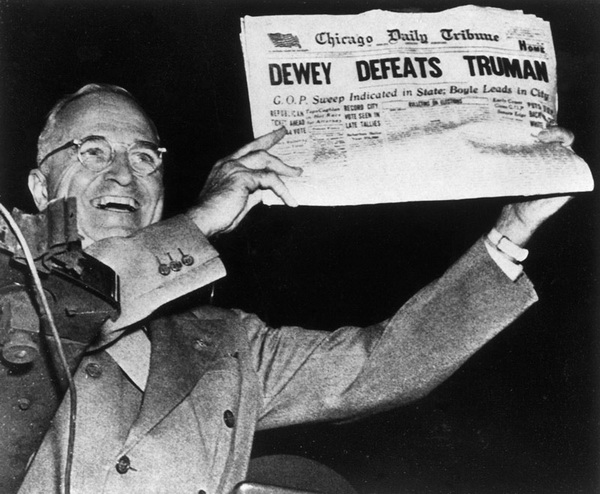
Did you read today's blog headline as a typographical error, an Olympics equivalent of the Chicago Tribune's headline following the 1948 election, "Dewey Defeats Truman" -- a triumph of hope over reality?
Not at all. It is the reality.
The fact is that, most of the time, winning an Olympics bid, like many other efforts at local boosterism, turns out to be a Pyrrhic victory.
There may be the equivalent of a Bernie Madoff here and there, promoting various community projects in an effort to make a personal profit. But my assumption is that most community cheerleaders, like modern day George Babbitts [Sinclair Lewis, Babbitt (1922)], with confidence and pride in their town truly believe that their idea -- whether an indoor rain forest, the world's largest ball of string, or hosting an Olympic event -- really will "put their city on the map," while bringing tourists and their tourists' dollars to town. Who needs a business plan when "everyone knows" what a great idea it is?
We hear it now from the restaurant and bar owners in Iowa City -- and the elected officials who promote their causes -- who are proposing to shoehorn the Hancher Auditorium replacement into a downtown Iowa City laid out 170 years ago, in 1839.
All too often the construction money can't be found, or the project is built but it turns out that "build it and they will come" only works in the movies. Or enough public debt is incurred that it is, with the declining revenues that could have been predicted but weren't, the death knell for the project and then -- like paying for a dead horse -- takes years, if ever, to pay off.
But there is no effort at community promotion for which there is a greater disparity between the promised economic benefits and the ultimate disappointment than Olympic venues (with the possible exception of the games held at this, the first venue for the games). Consider the following examples:
o The $2.7 billion debt following Montreal's 1976 Olympics was not paid off until 2005.
o Atlanta's 1996 hope of riches provided few if any increases in retail sales, hotel occupancy or airport traffic during the games. As economist Andrew Zimbalist reports, "The only variable that increased was hotel rates — and most of this money went to headquarters of chain hotels located in other cities."
o The excess costs in Sydney in 2000 were over $2 billion.
o Athens' budget in 2004 was $1.6 billion. The ultimate cost? $16 billion.
o An increase in tourism? As is often the case at Olympic events Athens suffered a 10% decline -- as those who would otherwise have visited at that time but wished to avoid Olympic crowds simply stayed away. A 2002 Utah survey indicated that 50% of the usual non-resident tourist skiers were planning to stay away during the winter games for that reason.
o The newly built facilities not only cost billions to build, they take valuable real estate -- and may involve the removal of those left with no housing -- only to sit unused, or underutilized, after the lights dim and the athletes depart.
o Rio is already projecting a cost of $14.4 billion, and it will be another seven years, and uncounted millions or billions more, before anyone will be saying "let the games begin" in 2016.
It's kind of like second prize is that your city gets to spend billions of dollars hosting the Olympic games for a few days and first prize is that you don't have to.
Or, otherwise put, Chicago can spend billions on the Olympics and feed visitors for a few days, or it can have a sensible business plan to bring midwesterners to Chicago by rapid rail and feed them for a lifetime.
And that's why, I think, Chicago won the bidding in Copenhagen.
[Source for data: See Andrew Zimbalist, "Not a Rosy Picture," in "Room for Debate: Do Olympic Host Cities Ever Win?" New York Times, October 2, 2009, and Andrew Zimbalist, "Economic impact of Olympic Games rarely adds up to much gold," Street and Smith's Sports Business Journal, August 1, 2005, p. 21. For Athens' $16 billion estimate see also "Montrealers identify with Athens' challenges," Canadian Press, CTV, August 5, 2004.] _______________ * Why do I put this blog ID at the top of the entry, when you know full well what blog you're reading? Because there are a number of Internet sites that, for whatever reason, simply take the blog entries of others and reproduce them as their own without crediting the source. I don't mind the flattering attention, but would appreciate acknowledgment as the source, even if I have to embed it myself. -- Nicholas Johnson