CONTENTS
Column
Readers' Comments
Updates
Sources
Football Update Stories
Last Saturday (Oct. 17) The Gazette published a column of mine, reproduced below. In it I offer a sampling of examples of how removing college football from the academy and operating it as a for-profit corporation would benefit every stakeholder (such as, university presidents, faculty, athletic directors, coaches, players, NFL, fans, advertisers, casinos and sports gambling).
Little did I imagine that this past week's news would provide even more evidence supporting this approach. Here are some stories -- and links to them if you want more details. They include:
o additional football related "diversity, equity, and inclusion" charges and $20 million lawsuit, now associated with the University, at a time when the UI is dealing with its own similar charges and defections.
o a major additional source of, and focus on, COVID-19 concerns when Iowa's failures in dealing with the pandemic make it among the most dangerous states in the country and the University has not been among the best in dealing with it.
o an association of the University of Iowa with the major politically divisive kurfuffle involving football players kneeling during the National Anthem at ball games
o University favoritism of athletes over other students, including a $230,000 bill for their hotel accomodations
Jeff Johnson, "Former Iowa football players threaten lawsuit, demand $20 million, firing of Gary Barta, Kirk and Brian Ferentz; University of Iowa rejects the demands," The Gazette (online), October 18, 2020 ("Eight former University of Iowa football players are demanding monetary compensation from the school and the firing of Hawkeyes head coach Kirk Ferentz, offensive coordinator Brian Ferentz and athletics director Gary Barta for intentional race discrimination, it was learned Sunday.") https://www.thegazette.com/subject/sports/hawkeyes/iowa-football/former-hawkeye-football-players-threaten-lawsuit-demand-20-million-firing-of-gary-barta-kirk-and-brian-ferentz-20201018
and see, Jeff Johnson, "Lawyer of 8 former Iowa football players asking for money and dismissals of Ferentzes and Barta responds; Iowa said it will not cede to his demands," The Gazette (online), October 19, 2020 (noting, "Iowa conducted an independent investigation of its football program over the summer through a Kansas City law firm, after many former Black Iowa players went on social media and expressed their negative experiences at the school, especially with strength and conditioning coach Chris Doyle.") https://www.thegazette.com/subject/sports/hawkeyes/iowa-football/lawyer-of-8-former-iowa-football-players-asking-for-money-and-dismissals-of-ferentzes-and-barta-responds-20201019
Jeff Johnson, "Purdue football coach Jeff Brohm out for game against Iowa after testing positive for COVID-19," The Gazette (online), October 19, 2020 "[Purdue head football coach Jeff] Brohm is the eighth FBS [Football Bowl Subdivision] head coach to contract COVID-19, joining Kansas’ Les Miles, Florida’s Dan Mullen, Florida State’s Mike Norvell, Toledo’s Jason Candle, Arkansas State’s Blake Anderson, UCLA’s Chip Kelly and Arizona’s Kevin Sumlin. . . . The Big Ten’s rules call for any player testing positive to be out of action for 21 days, while coaches are subject to regular CDC recommendations, which are for a 10-day self isolation.") https://www.thegazette.com/subject/sports/hawkeyes/iowa-football/purdue-football-coach-jeff-brohm-out-for-saturdays-game-against-iowa-after-testing-positive-for-covid-20201019
Jeff Johnson, "Iowa football players will have the option to kneel or stand for national anthem," The Gazette (online), October 20, 2020; in print edition as "Hawks Have a Say," October 23, 2020, p. B1 ("Some Iowa Hawkeyes football players will kneel for the national anthem Saturday at Purdue to call attention to racial inequality and social justice. . . . Head coach Kirk Ferentz confirmed that players will have the option to kneel or stand for the anthem. The team’s leadership group met with him three different times to talk about it. The football program, of course, was the subject of an independent investigation to look into accusations by former and current players of racial inequalities and bullying during Ferentz’s 22-year tenure as head coach. Strength and conditioning coach Chris Doyle lost his job, albeit with a $1.1-million settlement, and the investigation found that program rules 'perpetuated racial or cultural biases and diminished the value of cultural diversity.'”) https://www.thegazette.com/subject/sports/hawkeyes/iowa-football/hawkeye-football-players-will-have-the-option-to-kneel-or-stand-for-national-anthem-at-saturdays-season-opener-20201020
Jeff Johnson, "With Iowa football season finally here, daily testing and 'doing the right thing' can help it endure," The Gazette (online), October 23, 2020; in print edition as "COVID Football; Hawks return to field needing to do 'the right thing,'" October 24, 2020, p. B1 ("This is just the beginning of what . . . every player, coach and other personnel within the Iowa football program do on a daily basis during this surreal and delayed COVID-19 season. . . . This is nine straight weeks of games, with no byes. At least that’s what everyone hopes. COVID-19 might have other ideas. No one knows how this actually will turn out. No one.") https://www.thegazette.com/subject/sports/hawkeyes/iowa-football/with-iowa-football-season-finally-here-daily-testing-and-doing-the-right-thing-can-help-it-endure-20201023
Erin Jordan, "University of Iowa athletics spends $230K on hotel stays for coronavirus-positive student-athletes; Other University of Iowa students who test positive stay in residence halls," The Gazette, Oct. 10, 2020, print edition p. A1 ("The University of Iowa Athletic Department has spent more than $230,000 since June putting about 180 COVID-19-positive student-athletes up in hotel rooms and paying for their food. . . . The UI paid another $40,983 on per diem payments for student-athlete food while they were in hotel isolation.) https://www.thegazette.com/subject/sports/hawkeyes/university-of-iowa-coronavirus-covid-19-costs-athletes-hawkeye-football-20201020
Treat College Football Like Big Business
Nicholas Johnson
The Gazette, October 17, 2020, p. A6
In our capitalist, entertain-me society football will not, and need not, disappear. It just needs to stop being the muscular tail that wags the academic dog.
In 1906, when college football was killing 15 to 20 players a year, and permanently disabling 150 more, President Teddy Roosevelt told college presidents he’d outlaw the sport unless they made it safer. Reluctantly, they agreed to require helmets and organized what became today’s NCAA.
In 1939, University of Chicago President Robert Hutchins considered the school’s football team a distraction, scorned colleges that received more publicity from sports than education and research, and simply abolished football.
Today, few politically perceptive critics of football advocate the death penalty. So long as parents and players know the health risks, millionaires willingly play for billionaires in stadiums purchased by taxpayers, and fans know football’s cost in time and money, there will be football. [Photo credit: John Schultz/Quad City Times, Oct. 21, 2012.]
From preschool through college the goal is lifelong learning in a physically fit body. It’s what we’ve called “physical education” and the Greeks called “body, mind and spirit.”
College sports such as tennis, golf and swimming can provide benefits into one’s eighties. They’re as historically fundamental to curriculum as any classroom, lab, or studio course and should be funded as such.
College football is neither a student sport nor a career path. The NFL takes 1.6 percent of college players for an average stay of 3.3 years. It is a business, big billions business. In 40 states college football coaches are the highest paid public employees.
In a nation with obesity on the rise, cutting students’ lifetime sports so a farm club can send its ablest players through a cattle chute to the NFL is indefensible.
Moreover, college football creates conflicts of interest for everyone. University presidents find it easier to capitulate to coaches than fight. Athletic directors must rationalize taking advertising and skybox dollars from the alcohol and gambling industries. Coaches must encourage players’ in-class performance, while coaches’ multi-million-dollar salaries turn on players’ on-field performance. Non-tenured professors fear retribution for flunking players. Players who do seek a college education must choose between lab time and scheduled practice. [Photo credit: Nicholas Johnson, Riverside gambling casino ad on Kinnick Stadium big-screen display.]
There are many possible reforms. But what’s the win-win that preserves football while getting the elephant off the campus?
How about what the University did earlier this year when it contracted away its power plant – a perfectly legitimate university function -- to a for-profit, private utility?
Remove the football program from the University; recognize it as the part of the big money entertainment industry that it is. Let it lease the Kinnick Stadium, related land and structures, the “Hawkeyes” name, and associated assets at going commercial rates.
This farm club could pay its coach, and players, whatever its corporate board wished and employees could negotiate – eliminating the state’s embarrassment of the coach as highest paid public employee.
Remove the requirement players pretend to be students – while providing players who wanted to be students spring-semester-only and other accommodations. Get out from under other NCAA restrictions.
Iowa’s not the only football-challenged school. It shouldn’t be difficult to find enough more to make a league – and maybe even affiliate with the NFL, like baseball’s farm clubs.
Any lesser “accommodation” with college football will only perpetuate the conflicts.
_________________
Nicholas Johnson, a former FCC commissioner and sports law professor, provides more on this and other subjects at FromDC2Iowa.blogspot.com Contact: mailbox@nicholasjohnson.org
SOURCES
President Teddy Roosevelt. Weiler, et al, Sports and the Law, p. 747.
Robert Hutchins, University of Chicago. https://president.uchicago.edu//directory/robert-maynard-hutchins
College football players as NFL draftees. 1.6% http://www.ncaa.org/about/resources/research/estimated-probability-competing-professional-athletics
Average NFL career 3.3 years. https://www.espn.com/blog/nflnation/post/_/id/207780/current-and-former-nfl-players-in-the-drivers-seat-after-completing-mba-program
College football revenue. Top 100 teams 2014-15 $5.6 billion. https://www.ucribs.com/blog-post/ncaa-football-teams-made-more-money-than-many-nfl-teams-in-2015-infographic/
College coaches highest paid public employees in 40 states. https://fanbuzz.com/national/highest-paid-state-employees/
Overweight & obese. https://www.healthline.com/health/obesity-facts#1.more-than-one-third-of-adults-in-the-United-States-are-obese. (United States, 36.5% of adults are obese. Another 32.5 percent of American adults are overweight.)
UI’s power plant. “Iowa Facilities Management, Power Plant,” March 11, 2020, https://facilities.uiowa.edu/power-plant
READERS' COMMENTS
Posted to public on Facebook, with name:
Seems like a sensible solution to a long standing problem.
Steven Hulme, FB, Oct. 17, 7:37 AM
All good points!
Becky Jacobsen Strahl, FB, Oct. 17, 7:37 AM
FOOTBALL - This is an interesting perspective from Nicholas Johnson examining how to get better outcomes for sports programs and academic programs.
Resources for Life, FB, Oct. 17, 8:37 AM
This will definitely give you food for thought!!
Julie Johnson, FB, Oct 24, 3:40 PM
Posted to FromDC2Iowa, with readers' name:
This analysis is right on point. "College" athletics (in particular football and basketball) have not related to a University's primary mission for many years. The primary mission of a University is to educate. Not train for a career, not provide bread and circuses, not provide an "economic" engine for a town or a region -- the mission is to train minds and create a whole person to function in society. Does a football team "create spirit" for a University? Sure. But the proposed solution would continue to "create spirit" much in the way that, for example, Premier Football Teams create community spirit. And would allow the University to focus on its primary mission.
Prophet of Doom, Oct. 17, 7:49 AM
Thank you Mr. Johnson. It's a great idea. In my opinion football should not be played by any individual in organized sports until they are at least 21 years old. Any responsible, caring parent should not let their child subject themselves to the injuries that football causes, Sometimes permanet injuries for the rest of their lives.
Locally, we had a high school student who was a quadriplegic for the rest his life from injuries at at school football game. Sad. Very sad.
However, I purpose an alternative sport to football. School maintanence teams. Think of the poosibilities. There is many ways this can go. Start 'em in middle school. Or, if they were in band or chorus, everyone plays.
Iowa Tom, Oct. 19, 4:12 PM
Emails sent to mailbox@nicholasjohnson.org:
(senders' names omitted because email was a non-public communication for which use of name was neither requested nor granted.)
Subject: Genius
GENIUS solution for divorcing football from higher education. Thank you!!!
Oct. 17, 10:34 AM
Subject: Your editorial today
You are 100% on the mark regarding your editorial on college football. It has gotten totally out of hand. I used to have season tickets as a student in the 70’s and a faculty in the 80’s but the corporate takeover of college football has totally turned me off.
I always enjoy your editorials.
Oct. 17, 3:54 PM
Subject: Column "Treat college football like..."
I always learn something when I read one of your columns! I had not known of Teddy Roosevelt's ultimatum which led to the creation of the NCAA. I must commend you once again for not exempting the sacred cows when you "speak truth to power." Not only that, but you sign off with your real name and email address rather than using the distancing effect of the nom de plume...I mention this only because (I believe) there was a counter-example in the only letter to the editor on the same page as your guest column; methinks that the writer who called Chuck Grassley a "good egg" was not given the name "May Day" at birth. Judging by the gist of the letter, I doubt that the author was aligning themselves with the rather leftist implications that the holiday by that name has assumed over the years; judging by current polling trends, I rather suspect that the author was evincing a (Freudian ?) general call of distress. (A distress which might be best understood by those in East Iowa City who only have one yard sign in their front yard - "Phil Hemmingway for Supervisor - Republican" -- which may be signalling an orientation regarding other races which must remain veiled). But I digress.
Keep up the good work and stay well,
In '65 I was 17 - runnin' on empty...
Oct. 18, 2:03 PM
# # #
August 27, 2014, 7:10 a.m.; August 20, 2014, 1:10 p.m.
September/October 2020 NOTE
READ THIS NOTE if you are coming to this 2014 blog post from a link in a newspaper letter to the editor during the fall of 2020.
Given the 200-250-word limit on letters to the editor, much of what needs to be said about the impact of college football and alternative ways to provide it could not be included in that letter.
There are three categories of elaboration of that letter within this 2014 blog post.
(1) Conflicts of interest created by college football. The following paragraph appears below:
The cancer has metastasized its conflicts of interest for everyone in higher education who touches it. University presidents find it easier to capitulate to athletic directors and coaches than to fight (Penn State). Non-tenured professors have to weigh how flunking a football starter may affect their career. Coaches must give a nod to players' academic performance, but know that their own multi-million-dollar salaries are much more closely tied to their players' on-field performance. When players' become criminal defendants, ideals of players' personal integrity may conflict with a team's ability to win games. Conventional students are excluded from participation, suspect favoritism for team members, and use football as an additional excuse for drunkenness. Players who really would like a substantive college education are forced to choose between lab time and scheduled practices.
(2) Refashioning college football. There are athletes in their late teens and twenties who want to play football. There are fans who want to see them play.
Some individuals are so concerned about the range of physical and mental injuries (including multiple concussions) many football players endure for the rest of their lives that they urge the abolition of the sport, or refuse to let their children participate. That is not my position. So long as parents and participants are fully informed of the risks, have not been manipulated, and are willing to accept those risks and the costs of potential lifetime rehabilitation, football will continue.
The proposal is that a university's football program be spun off from the university and absorbed into a for-profit private corporation. Decisions from the university's "athletic department" would no longer be driven by what's best for football, but what's best for students' physical fitness as participants rather than mere spectators of sports.
Here are some excerpts from the discussion of this proposal below:
Spin off the schools' football programs, leave them free from NCAA regulation and the conflicts inherent in their association with higher education. As for-profit corporations they will be less subject to criticism for what their boards of directors agree to pay their coaches -- and players. Remove the requirement that the players pretend to be college students during the football season and associated practice times.
The rest is "administrative detail" -- detail admittedly not insignificant, and possibly even deal-breaking. But detail that is not the central issue. The separate commercial football corporations could continue to lease the facilities (Kinnick Stadium) and name (Hawkeyes) they were using before. (It's unlikely any school would require a football stadium as a venue for a poetry reading.) Players who wanted to get a college education might be given some special consideration as a result of an agreement between the team and the formerly-associated school -- such as, say, a degree program requiring only attendance during spring semesters. But there would be no requirement that they be "college students." . . .
Maybe it won't be accomplished during my lifetime (given my age). But it's an idea that needs to be back on the table as a possible win-win solution to a battery of conflicts and other challenges confronting millions of Americans.
When there is a cure for a cancer of any kind -- whether on the presidency of the United States, or the presidencies of major universities -- it does seem a shame not to make use of it.
(3) Other football-related problems. Below, click here "Prior College Football-Related Blog Essays, 2010-2014", is a list of blog posts and columns organized by some of the other problems associated with college football: "The College Football Industry (impact, economics, crime, future)," "Football's Ties to Alcohol," "Football's Ties to Gambling," and "Impact of Fans on Stadium Neighborhood." (Not listed are additional football-related blog essays from 2006-2009.)
(4) At the very bottom of this blog post is an earlier entire column on this subject in the Iowa City Press-Citizen, August 27, 2014, headlined "Let's Stop Making Players Pretend to Be Students."
____________________
Notes: (1) This morning [Aug. 27, 2014] the Iowa City Press-Citizen published a hard copy and online opinion column drawn from this blog essay. It is reproduced below.
(2) Near the bottom of this blog essay is a list of "Prior College Football-Related Blog Essays, 2010-2014." They are grouped by: "The College Football Industry (impact, economics, crime, future)," "Football's Ties to Alcohol," "Football's Ties to Gambling," and "Impact of Fans on Stadium Neighborhood." (Not listed are additional football-related blog essays from 2006-2009.)
_______________
We have a cancer--within, close to the Presidency, that's growing. It's growing daily. It's compounding, it grows geometrically now because it compounds itself.
--John Dean to President Richard Nixon, March 21, 1973
"Transcript of a Recording of a Meeting Among the President, John Dean, and H.R. Haldeman in the Oval Office," March 21, 2073, 10:13 to 11:55 a.m.," Watergate Trial Conversations, Nixon Presidential Library & Museum.
_______________
John Dean, President Nixon's Chief White House Counsel, famously warned his boss that the Watergate burglary was like a cancer growing on the Presidency.
I'm no doctor, but with the opening of yet another college football season, somebody needs to tell the presidents of the big money football schools about the cancer growing on "the academy."
There have been earlier diagnoses of this disease.
In 1906, when college football was killing 15 to 20 players a year, and permanently disabling 150 more, the President of the United States, Teddy Roosevelt, told college presidents he'd outlaw the sport unless they made it safer. Reluctantly, they organized and agreed to require helmets -- ultimately evolving into today's NCAA. Weiler, et al, Sports and the Law, p. 747.
My friend, Robert Maynard Hutchins, was appointed President of the University of Chicago when he was 30 years old. He considered Chicago's football program a distraction from the school's educational mission, pulled out of the Big Ten, and simply abolished the program. (
"Hutchins heaped scorn upon schools which received more press coverage for their sports teams than for their educational programs, and [gained] the trustee support he needed to drop football in 1939.")
Although Hutchins' analysis and solution are even more persuasive now than 75 years ago, few politically perceptive football critics are today advocating the death penalty for football -- nor am I. If parents and players know the health risks, taxpayers know the costs, fans and TV viewers want to invest their time (and money) watching, the libertarian position seems pretty clear. We will continue to have football.
Moreover, there is a win-win cure for this cancer on the academy that would solve current challenges confronting both higher education and big-money college football.
The cancer has metastasized its conflicts of interest for everyone in higher education who touches it. University presidents find it easier to capitulate to athletic directors and coaches than to fight (Penn State). Non-tenured professors have to weigh how flunking a football starter may affect their career. Coaches must give a nod to players' academic performance, but know that their own multi-million-dollar salaries are much more closely tied to their players' on-field performance. When players' become criminal defendants, ideals of players' personal integrity may conflict with a team's ability to win games. Conventional students are excluded from participation, suspect favoritism for team members, and use football as an additional excuse for drunkenness. Players who really would like a substantive college education are forced to choose between lab time and scheduled practices.
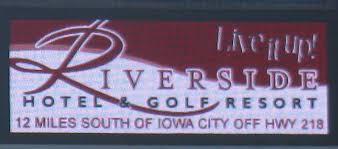 As this photo of a Kinnick scoreboard ad reveals, athletic directors are forced to rationalize why it's OK to take advertising and sky box dollars from the alcohol and gambling industries. The IRS struggles with the propriety of granting tax deductions when fans make "contributions" to a big-money football program as a condition of the opportunity to buy better tickets. [Photo credit: Nicholas Johnson.]
Inevitably, the college administrators, who want to put the best possible face on their schools for the benefit of reassuring parents, attracting students, favorably impressing other academics, granting authorities, Regents, legislators, and the public, are left trying to explain away football's controversial externalities. There are the players' criminal records, the football-associated student binge drinking and sexual assaults, the associated reputation as one of the nation's top "party" schools, the fans' trash throughout the stadium's neighborhood, and charges that painting the opponents' locker room pink is unacceptably anti-feminist -- things for which "the university" is not really responsible, but which challenge its administrators and tarnish its reputation anyway; e.g., Kembrew McLeod, "Pink Locker Room Doesn't Even Pass the Giggle Test," Iowa City Press-Citizen, August 26, 2014, p. A5. [Photo credit: Des Moines Register, 2006.]
These days, the conflicts, chaos, and controversies are making life more difficult for the big-money football programs as well.
The NCAA still lives in its dreamworld of the 1906 academically accomplished students who played football without helmets just for the fun of it, and the college professors who doubled as their volunteer coaches. This vision becomes increasingly difficult to market now that, as CNN reports, the 68 top teams took in $2.2 billion in 2010. Chris Isidore, "College Football's $1.1 Billion Profit," CNN Money, December 29, 2010. The highest paid public employee in most states is some school's football coach. Student athletes? How many schools pay department heads millions of dollars a year? (For the details by school see ESPN's shocking, revealing, "College Athletics Revenues and Expenses - 2008." As just one example, the Hawkeyes ranked 16th that year by revenue. Of the top 17 schools, 7 gave their students free admission to the games played by their "student-athletes." The Hawkeyes still consider the UI's students as "customers" rather than students and charges them significant ticket prices to attend the games played by "their" school's fellow "students.")
College players want to unionize, to be paid more of their full costs of attending college, and a share of the millions the schools make off of their likenesses and jersey numbers in fantasy football video games and clothing sales. Byron Tau, "NCAA Hires New Lobbyists for Amateurism Fight," Politico, June 13, 2014 ("The NCAA is facing a number of existential legal and legislative threats to its current system of unpaid student-athletes").
"No pain no gain" is football's mantra. Players want compensation for the healthcare costs from football related concussions and other injuries that may last a lifetime -- a minor form of which is portrayed in this photo of an injured Iowa tackle, Brandon Scherff, screaming in pain during Penn State game at Kinnick, October 20, 2012. [Photo credit: John Schultz/Quad City Times, Oct. 21, 2012.]
Conferences are expanding. The once-midwest-centered "Big Ten" schools are now 14, including Penn State, Rutgers, and Maryland -- well to the east of Iowa. The football-wealthiest schools, and their conferences, have just negotiated a withdrawal from some of the NCAA's restrictive regulations.
In short, from a variety of perspectives this is not your great grandfather's college football.
So what's the win-win cancer cure for America's universities and their big-money football programs?
Start by recognizing them for what they are -- profit-making, commercial organizations, serving as farm clubs for the NFL (even if only 1.6% of college players will be NFL draftees), organizations largely disconnected from the research, scholarship, and classroom instruction of their loosely affiliated university. Spin them off, leaving them free from NCAA regulation and the conflicts inherent in their association with higher education. As for-profit corporations they will be less subject to criticism for what their boards of directors agree to pay their coaches -- and players. Remove the requirement that the players pretend to be college students during the football season and associated practice times.
The rest is "administrative detail" -- detail admittedly not insignificant, and possibly even deal-breaking. But detail that is not the central issue. The separate commercial football corporations could continue to lease the facilities (Kinnick Stadium) and name (Hawkeyes) they were using before. (It's unlikely any school would require a football stadium as a venue for a poetry reading.) Players who wanted to get a college education might be given some special consideration as a result of an agreement between the team and the formerly-associated school -- such as, say, a degree program requiring only attendance during spring semesters. But there would be no requirement that they be "college students."
Once the major college football teams are out from under the NCAA's regulations, there should be no problems with the professional leagues' requirements. It is at least already possible in some situations for high school athletes who have not attended college to join a professional team in the NBA, NFL, NHL, or a professional baseball team's farm club.
Could all this be accomplished before the Hawkeyes' opener against University of Northern Iowa this forthcoming Saturday, August 30? Of course not. Maybe it won't even be accomplished during my lifetime (given my age). But it's an idea that needs to be back on the table as a possible win-win solution to a battery of conflicts and other challenges confronting millions of Americans.
When there is a cure for a cancer of any kind -- whether on the presidency of the United States, or the presidencies of major universities -- it does seem a shame not to make use of it.
_______________
Prior College Football-Related Blog Essays, 2010-2014
The College Football Industry (impact, economics, crime, future)
"The $100 Million Hawkeyes' Football Team; Hawks: "How Do I Love Thee? Let Me Count the Dollars," Aug. 28, 2010
"Coach Ferentz Provides Classy Variety of Wins; Winning Isn't Everything," Nov. 22, 2010
"Fandom; Super Bowl, Super Mystery," Jan. 30, 2011
"Super Boosters' Super Bowl; Campions' Wins Can Be Taxpayers' Losses; Lessons for Iowa," Feb. 8, 2011
"Crisis Communications 101; There Are Three Steps," Feb. 14, 2011
"Hawkeye Football Players' Criminal Records; We're Number Two! We're Number Two!," March 3, 2011
"Felons as Student Athletes; Felons on the Field; From District Court to Basketball Court; Do Hawkeyes Check Criminal Records Before Awarding Scholarships? March 27, 2011
"College Football Scandals Larger Lessons; Football's Privileged Tip of Abuses by Powerful," Nov. 8, 2011
"Peak Oil, Peak Football; $80,000 for the Seat; $3750/Year to Sit In It," Jan. 21, 2012
"What America Most Highly Values; In 23 of 50 States It's Football Coaches," Aug. 16, 2013
Football's Ties to Alcohol (and see, "Impact of Fans on Stadium Neighborhood," below)
"A Busch in the Hand is Worth . . . Who Knows? They Won't Tell Us," June 16, 2012
"'We're # 2!' . . . in Campus Drunks; Coach: Players Should Drink in Dorms, Not Downtown," Aug. 21, 2012
"UI Administrators 'Shocked' By School's Beer Ads; Who Could Have Guessed?" Aug. 30, 2012
Football's Ties to Gambling
"Does Herky Have a Gambling Problem? NCAA vs. Hawkeyes," Jan. 25, 2012
Impact of Fans on Stadium Neighborhood
"Football Trash Talk; Iowa City: Where Great Minds Drink Alike," Sept. 12, 2012
"Anheuser-Busch, UI & Hawks a Win-Win-Win; Advertising Pays," Sept. 17, 2012
"Clean Streets and Creative Consumption," Sept. 30, 2012
"'GO, HAWKS!' -- Just Not in My Yard; Homecoming's Public Urination," Oct. 5, 2013
_______________
Note: On August 27, 2014, the Iowa City Press-Citizen ran excerpts from this blog essay as an op ed column. Its online version is reproduced below; [brackets] identify the text as submitted, and contained in the online version, that was deleted from the hard copy version.
Let's Stop Making Players Pretend to Be Students
Nicholas Johnson
Iowa City Press-Citizen, August 27, 2014, p. A11
John Dean, President Nixon’s chief White House counsel, famously warned his boss in 1973 that the Watergate burglary was a cancer growing on his presidency.
With the opening of the college football season, somebody needs to warn the presidents of big-money football schools that there’s a cancer growing on their presidency.
There have been earlier diagnoses of disease.
In 1906, when college football was killing 15 to 20 players a year, and permanently disabling 150 more, U.S. President Teddy Roosevelt told college presidents he’d outlaw the sport unless they made it safer. Reluctantly, they agreed to require helmets and organized what became today’s NCAA.
University of Chicago President Robert Maynard Hutchins considered Chicago’s football team a distraction, scorned colleges that received more publicity from sports than educational programs, and with trustee support simply abolished football in 1939.
Hutchins’ analysis and solution are even more persuasive today. But few politically perceptive football critics advocate the death penalty — nor do I. So long as parents and players know the health risks, taxpayers know the costs, fans know its cost in time and money, and all still want football, we’ll have it.
Moreover, there is a win-win cure for this cancer that would solve current challenges confronting both higher education and big-money college football.
The cancer has metastasized its conflicts of interest for everyone in higher education. University presidents find it easier to capitulate to coaches than fight (Penn State). Athletic directors must rationalize taking advertising and skybox dollars from the alcohol and gambling industries. [Coaches must encourage players’ academic performance, while their multi-million-dollar salaries turn on players’ on-field performance. Non-tenured professors fear flunking players.] Players who do seek a college education must choose between lab time and scheduled practice.
Nor is the current system loved by the big-money football programs.
The NCAA lives in a 1906 dream world peopled with academically accomplished students playing football without helmets just for fun, and the college professors who doubled as their volunteer coaches. This vision is an increasingly tough sell when the highest paid public employees in most states are football coaches, and their college football industry grosses billions of dollars a year.
College players want to unionize, to be paid the full costs of attending college, and a share of the millions schools make from their likenesses in video games. They want reimbursement for the healthcare costs of football-related concussions and other injuries that may last a lifetime.
[Conferences are expanding. The once-midwest-centered Big “Ten” schools are now 14, including Penn State, Rutgers, and Maryland -- well to the east of Iowa. The football-wealthiest schools, and their conferences, have just negotiated a withdrawal from some of the NCAA’s restrictive regulations.]
[In short, this is not your great grandfather’s college football.]
What’s the win-win cancer cure?
Recognize the big-money college football programs for what they are — profit-making, commercial entertainment organizations, serving as farm clubs for the NFL (even if only 1.6 percent of college players will be NFL draftees), substantially disconnected from the research, scholarship, and classroom instruction of their schools.
Free them from NCAA regulations and their inherent conflicts. Remove the requirement players must pretend to be college students.
The rest is administrative detail. Most professional leagues already have provisions for players who’ve not attended college. Perhaps the football corporations could lease their former facilities (Kinnick Stadium) and name (Hawkeyes). Players who want an education might have a degree program permitting spring-semester-only enrollment.
When there is a win-win cure for a cancer of any kind, it’s a shame to refuse even to talk about it.
__________
Nicholas Johnson, a former FCC commissioner and sports law professor, provides more on this and other subjects at FromDC2Iowa.blogspot.com.
# # #


