August 17, 2008, 11:30 a.m., 2:30 p.m.
Currently Most Popular Blog Entries
"Earthpark: 'Pretty Quiet Phase; No Timetable to Speak of,'" August 14, 2008.
"UI Sexual Assault Update," July 19-August 9, and related Web page, "University of Iowa Sexual Assault Controversy -- 2007-08," July 19-present.
"Media's Medicines," August 12, 2008.
"How to Build an Indoor Rain Forest," July 10, 2008.
"Georgia on My Mind," August 13, 2008.
"Police Accidental Shootings -- Of Themselves," May 9, 2008.
"Random Thoughts on Law School Rankings," April 29, 2008.
Forbes and Ferentz
Forbes magazine has been ranking colleges and universities -- and their football coaches. Forbes is no friend of the University of Iowa. It ranks the University 331 out of the 569 ranked schools. Hana R. Alberts, Michael Noer and David M. Ewalt, eds., "America's Best Colleges," Forbes, August 13, 2008, 6:00 p.m.
And while "We're Number One!" "We're Number One!" in at least one category, we'll probably want to consider postponing any public celebrations of the honor.
Forbes ran a kind of comparative benefit-cost analysis of what every college football coach is being paid, and what they are producing for the money. The University of Iowa came in number one in the nation for "most overpaid coach."
Peter J. Schwartz, "The Business Of College Football; The Best (And Worst) College Football Coaches For The Buck," Forbes, August 13, 2008, 6:00 p.m. ET ("But the best bargain was Ohio State’s Jim Tressel, who scored a 122. Tressel has led the Buckeyes to the last two national championship games (losing to Florida in 2007 and Louisiana State in 2008) and was paid $2.6 million last season, less than eight of his peers. . . . The most overpaid coach is Iowa’s Kirk Ferentz, who made $3.4 million last year despite lackluster results on the field, for a score of 71. Just how lopsided is Ferentz’s deal? During the last three years he’s pocketed $10 million, including a record $4.7 million in 2006, but has led the Hawkeyes to just a 19-18 record.").
If the Press-Citizen's Pat Harty is to be believed, it doesn't look all that much better for the 2008 football season. Pat Harty, "Lack of competition for starting jobs is alarming," Iowa City Press-Citizen, August 17, 2008, in this morning's paper as, "Offense Up in the Air; Lack of Desire is Alarming," p. B1.
Of Mural and Money
Fungibles -- whether bushels of graded corn or cars -- have cost, market price, and based on their potential use by the owner, a "value." Lose one, or break one, and you can just buy another. "It's only money."
Irreplaceable natural resources, such as petroleum, are thought to have a "value," and price, that are merely equivalent to the cost of removing and consuming them (plus profits) -- not the millions of years it will take to replace them, or the billions of dollars it will take to find replacements for a fossil-fuel-based economy. It's "use it and lose it."
Paintings, or a multi-generation family Bible, likewise, have a cost (materials and artist's time) and market price. But their "value" is something that exits separate and apart from the economist's realm.
And so it is with the UI's Jackson Pollock painting. See, Nicholas Johnson, "Selling the Pollock" in "Floodplains, Art and Celebrities' Affairs," August 9, 2008, and . . .
Editorial, "True value of Iowa's art? Priceless," Des Moines Register, August 17, 2008 ("'Mural' belongs to the people of Iowa - those alive today and future generations. It's one of Iowa's gems, the same way public land, artifacts, monuments and rare documents are pieces of this state's history. . . . Iowa leaders should recognize the value of these items and places - beyond what they could bring at an auction.").
Pamela White, "What's the value of 'Mural'? Irreplaceable," Iowa City Press-Citizen, August 16, 2008 ("Museums have stringent standards regarding when it is appropriate to sell artwork from their collections. Donors give their art to museums in trust so future generations may enjoy and learn from them, and it is the duty of the museum to honor the donor's intention and to ensure that the art remains in public, not private, hands.").
Performance and Poverty
Richard Doak, who has had a long and distinguished journalistic career, including as an editor and columnist, is in fact one of Iowa's best sources of thoughtfully creative public policy analyzes. This morning he lays out a persuasive case for increasing educational performance by decreasing poverty. Richard Doak, "Best reform in education? End poverty," Des Moines Register, August 17, 2008 ("Poverty in itself does not produce low student achievement, but the conditions of life for children in poverty are not conducive to learning. . . . In the richest country in the world, a certain level of poverty seems to be increasingly intractable, chronically pushing down the average on test scores, among other social pathologies.
Finland, South Korea, Canada, Japan and other countries that outperform the United States in education are not as wealthy as America, but their gaps between rich and poor are not as wide. The wealth they do have is more evenly distributed. So is their student achievement.
We might not want to talk about it, but one of the most serious problems in contemporary America is the deep and widening chasm between rich and poor. There is a segment of the population . . . who are at risk of becoming members of a permanent underclass . . . in which poor and undereducated parents beget poor and undereducated children. . . .
[P]oliticians find it convenient to blame the schools, bash teachers and demand non-solutions such as vouchers. The political right chants a mantra that is uttered like one word: thefailingpublicschools.
Wrong. It is not the public schools that are failing. It is the larger American culture and economy.").
Look Who's Running for President
Jason Clayworth, "Seven presidential candidates on ballot," Des Moines Register, August 16, 2008,
"Iowans will have seven presidential candidates to choose from when they go to the polls in November," and here they are:
"PRESIDENT: (In addition to Republican John McCain and Democrat Barack Obama) Bob Barr, Wayne A. Root for the Libertarian Party; James Harris, Alyson Kennedy for the Socialist Workers Party; Gloria La Riva, Robert Moses for the Socialism and Liberation Party; Cynthia McKinney, Wendy Barth for the Green Party; Ralph Nader, Matt Gonzalez for the Peace and Freedom Party."
. . . Knock, knock. Who's there? Shmoo. Shmoo who?
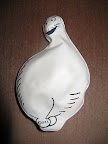 A high school friend who has been staying at our home just gave me what I guess is what we used to call a "house gift." It's called a "shmoo" (spelled by some as "schmoo").
In case shmoon (the plural) are unfamiliar to you, permit me to quote a line from the Wikipedia lengthy entry: "A shmoo (plural shmoon, also shmoos) is a fictional cartoon creature. It first appeared in Al Capp's newspaper comic strip Li'l Abner, on August 31, 1948."
In short, the Shmoo is coming up on his or her 60th birthday.
The only reason I mention this gift at all, thereby risking your judgment that I have finally totally fallen off the ledge, is because the donor is curious to know how many of you out there have any memory of these creatures -- or in fact actually have one of your own. I think it is social science research of some kind. Feel free to attach your comments to this blog entry and I'll pass them along to him.
# # #
August 9, 2008, 6:10 p.m.
[Note: The "Sexual Assault Update," July 19-August 8, 2008, blog entry remains at its former location; however, any updates to it following August 8, 2008, will be found, along with the blog entry as of August 8, at a new Web site, Nicholas Johnson, "University of Iowa Sexual Assault Controversy -- 2007-08."]
Now . . . Back to a Range of Subjects
Floodplains and Flood Planning
There were more than a couple of lines in Coralville City Administrator Kelly Hayworth's op ed this morning that caught my eye:
"Continued development in the Iowa River Landing will include generous areas of open space along the river . . .. We will work toward dedicating that area [the banks of Biscuit Creek] to green space in the future.
"The Iowa River is one of our greatest assets, and incorporation of green space is a dual-purpose project, allowing us to provide access to the waterfront while also practicing floodplain management."
Kelly Hayworth, "Coralville's post-flood development; Progress will be 'mindful of the flood but not ended by it,'" Iowa City Press-Citizen, August 9, 2008.
What I'd like to see is for Coralville, Iowa City, Cedar Rapids -- all of Iowa's communities along rivers -- to come up with 30-to-75-year plans regarding their flood plains.
Building roads, parking lots, malls, suburban and businesses in floodplains just multiplies the disastrous consequences of floods. Not only does it mean the economic losses will be greater when floods occur, but the rapid runoff it accelerates also means that the floods will occur more often, be of greater seriousness, and the water will run off and rise faster than with consciously developed floodplains.
We need to have recreational areas, wildlife habitats, prairies and pastures, biking and jogging trails, and wetlands somewhere. And Iowa is virtually last in the nation at the moment in our set-asides of land for such purposes. By using land in the floodplains along our rivers for these purposes we get a dual benefit -- radical reduction, if not elimination, of the economic losses from flood damage, and access to these multi-purpose acres that shouldn't be used for anything but recreation and wildlife habitats anyway.
So why a 30-to-75-year plan? Because I wouldn't want to pull off something like this in five or ten years even if we could -- and politically we simply can't. Like using attrition rather than firing when a workforce needs to be reduced, giving owners incentives and as much time as possible to arrange for moves makes it easier on everyone.
Whether we want to provide humanitarian aid to those ravaged by floods (as distinguished from funds for rebuilding) is a subject I'm open to discussing but need not now address.
But it seems to me kind of obvious that we should (1) clearly define the 500-year-floodplain for the relevant rivers; (2) draw up a plan as to how that land might best be used once our project is concluded; (3) forbid any new building (or expansion of the footprint) of homes, businesses, parking lots or roads in floodplains; (4) use every available incentive (such as buyouts) to discourage rebuilding or repair; (5) prohibit the construction of public buildings on such land; (6) prohibit the use of any public money, or tax incentives such as TIFs, for for-profit or non-profit businesses operating in floodplains, and (7) immediately begin the process of conversion, by removing buildings and roads where we can, planting prairies, pastures, trees, and the grasses with root systems that can operate as filters near rivers, and start the demonstration of what wise floodplain planning and stewardship can look like.
Selling the Pollock
The Press-Citizen got it right this morning in its Editorial, "Don't sell priceless 'Mural' to pay off flood damages," Iowa City Press-Citizen, August 9, 2008 ("Although [selling Jackson Pollock's 'Mural' painting] might make sense to business school professors, we said it recognized neither the historic importance of Pollock's painting nor how "Mural" has been identified with UI for three generations. A gift to UI from art collector Peggy Guggenheim in 1953, 'Mural' predates the museum itself -- which opened in 1969 -- and is arguably the most important item in the museum's permanent collection. . . . Last year, we said neither Iowa nor the university should surrender the great in order to purchase the mediocre."
There are a couple of issues here -- aside from the old line about "those who know the price of everything and the value of nothing."
(1) I'm reminded of a case some years back when the UI Foundation was given a farm -- with stipulations. Can't swear I've got the facts right, but as I recall them the donor wanted to insure that the tenant on the farm could continue to farm it. The Foundation took the position that once it got the property it could do with it what it wanted -- and what it wanted did not include carrying out the donor's wishes.
I don't know what Ms. Guggenheim had in mind when she donated the Pollock, but knowing something of her commitment to art I can't imagine that she thought the great gift she was giving the University was nothing more than the equivalent of shares of stock, something to be sold whenever the University decided it would rather have the cash the painting could bring at an art auction.
(2) It's not like major gifts of this kind were purchased by Iowa's taxpayers -- who could subsequently legitimately decide to sell them for the money. These were gifts. But for donor generosity we'd never have had the property in question. And the more we unilaterally treat such gifts from the past with such disrespect the less likely we are to receive such gifts in the future. Selling the Pollock is self-defeating over the long run.
(3) Anytime the state, or one of its universities, wants to sell something of extraordinary and irreplaceable value -- I recall the sale of WOI-TV -- I think about how much cash we could get from a sale of Iowa's topsoil. I'm sure there's some guy in Arizona -- or the Middle East -- who would give us big bucks for it. Provide a little water for irrigation and it could create some of the world's best farmland in a desert anywhere on earth.
(4) There are "values" that exist separate and apart from what something will sell for. Have you ever had the experience of reaching for the Phillips screwdriver, or ballpoint pen, in the place to which it was supposed to be returned, and found it wasn't there? Was your reaction affected by the fact that you probably couldn't have sold the ballpoint pen at auction for even 10 cents? Is the home you live in affected by the fact it's now worth 10 times what you paid for it -- when it's the same square feet, with the same view out the front windows -- aside from the fact that you're paying many times more in property tax? So it is with a painting; the quality it has, the pleasure it gives you, the skill of the artist it reflects, is not a function of its dollar value.
So what do I really think? Yeah, I guess you'd have to count me among those -- a group that includes UI President Sally Mason ("I do not want to sell the painting. Let me be fully clear") -- who think we ought to keep the Pollock. Brian Morelli, "Regents to Put Value on UI's Pollock Painting," Iowa City Press-Citizen, August 7, 2008.
The John Edwards Affair
I have little or no interest in reading, or commenting, about the August 8 story, and ABC Nightline interview, regarding the details of a 2006 affair of John Edwards.
But there's a quote from his interview that I do think worth repeating:
"I went from being a senator, a young senator to being considered for vice president, running for president, being a vice presidential candidate and becoming a national public figure. All of which fed a self-focus, an egotism, a narcissism that leads you to believe that you can do whatever you want. You're invincible. And there will be no consequences."
Rhonda Schwartz, Brian Ross, and Chris Francescani, "Edwards Admits Sexual Affair; Lied as Presidential Candidate; In an ABC News Nightline Interview, Edwards Reveals He Cheated, But Didn't Father Child," ABC News, August 8, 2008.
It's not an exculpatory statement, certainly, and I have no reason to believe it was intended to be. But I do think it is revealing and insightful, and perhaps of some use to those -- whether intrigued or repulsed -- by the behavior of celebrities, whether athletes, politicians, TV/movie stars, rock musicians, corporate executives, or those merely famous for being famous.
The remarkable thing is not that so many public figures seem to fall ill to the condition/attitude he describes but that there are so many who do not.
It's a quality, a characteristic, a kind of pressure on public figure, that should be of interest to all of us in the business of picking our public officials in primaries and elections -- from school board to president -- as well as a subject for study by psychologists and psychiatrists, and political scientists.
It's a notable comment because that kind of self-diagnosis is rare from anyone, but especially those who, by dint of their position, end up having to make very public apologies for their behavior.
# # #
 A high school friend who has been staying at our home just gave me what I guess is what we used to call a "house gift." It's called a "shmoo" (spelled by some as "schmoo").


